
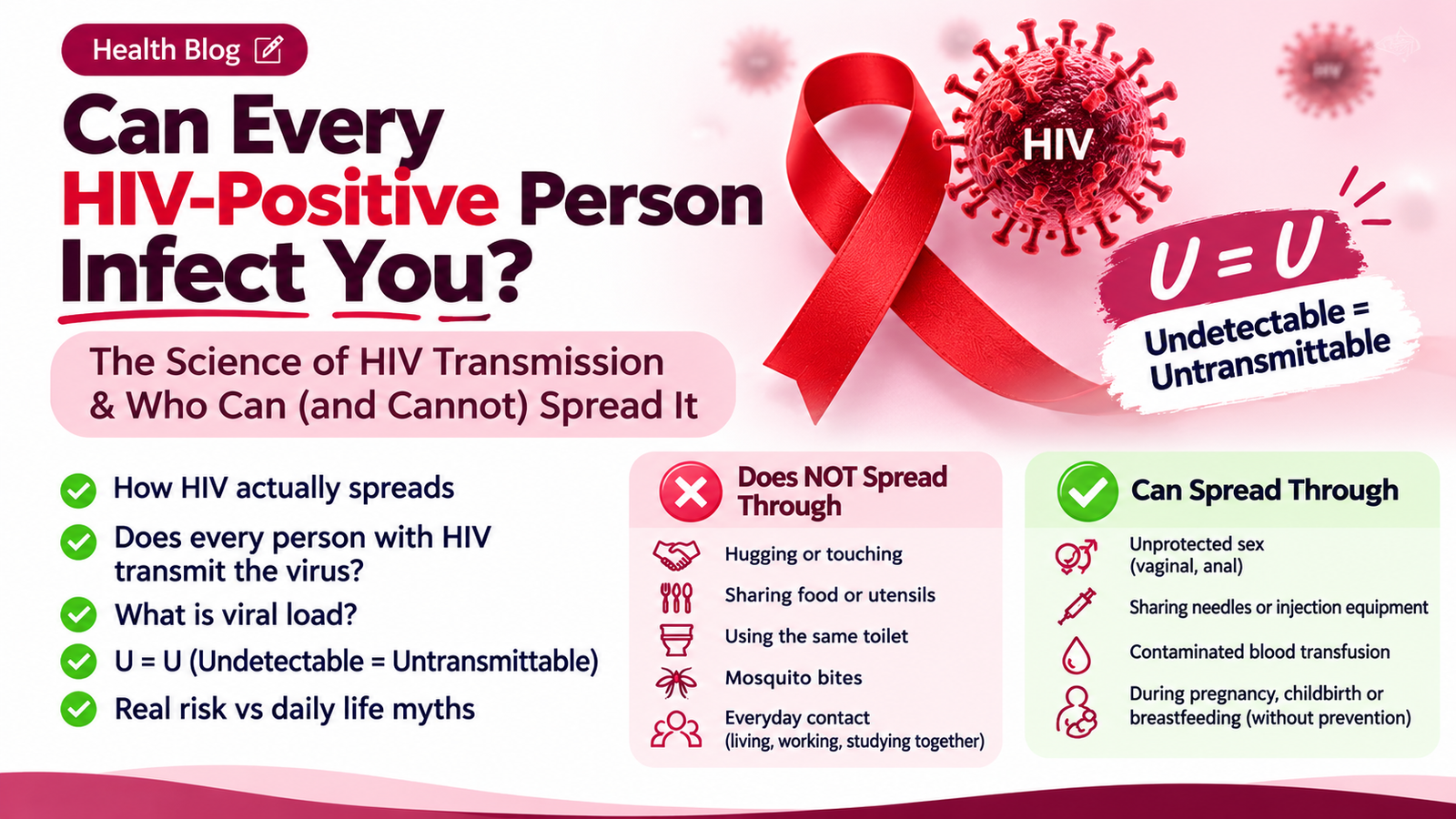
Not everyone living with HIV can transmit the virus. And not every exposure to HIV leads to infection.
One of the biggest misconceptions about HIV is that simply coming into contact with someone who is HIV-positive puts you at risk.
- But HIV transmission is more complicated than that.
Let’s understand the science behind HIV transmission, infectious body fluids, viral load, and the situations in which HIV cannot spread.
1. What Is HIV and How Does It Spread?
Human Immunodeficiency Virus (HIV) attacks the immune system, particularly CD4 T lymphocytes.
HIV transmission requires three important conditions:
- A source of HIV: A person living with HIV who has a transmissible viral load.
- An infectious body fluid: Blood, semen, pre-seminal fluid, vaginal fluids, rectal fluids, or breast milk.
- A route of entry: Through mucous membranes, damaged tissue, direct injection into the bloodstream, or certain other exposures.
Simply touching someone living with HIV does not transmit the virus.
2. Can Every HIV-Positive Person Transmit HIV?
No. This is where viral load becomes important.
Viral load refers to the amount of HIV present in a person’s blood.
A person with HIV who takes antiretroviral therapy (ART) consistently can achieve an undetectable viral load.
Undetectable = Untransmittable (U=U)
Scientific evidence confirms that people living with HIV who maintain a viral load below 200 copies/mL do not transmit HIV through sexual contact.
This is called U=U: Undetectable = Untransmittable.
However, U=U specifically refers to sexual transmission. It should not be assumed to eliminate transmission through shared needles or breastfeeding.
A person with HIV who is not receiving effective treatment may transmit HIV, even if they appear completely healthy.
3. Which Body Fluids Can Transmit HIV?
| Body fluid | HIV transmission potential |
|---|---|
| Blood | Yes |
| Semen | Yes |
| Pre-seminal fluid | Yes |
| Vaginal fluid | Yes |
| Rectal fluid | Yes |
| Breast milk | Yes |
| Saliva | No, through ordinary contact |
| Sweat | No |
| Tears | No, unless unusually contaminated with infectious blood |
| Urine | No, unless contaminated with infectious blood |
Important: Detecting traces of HIV in a body fluid does not automatically mean that the fluid can transmit infection.
The amount of infectious virus and the route of exposure matter.
4. Who Can Transmit HIV to You?
HIV can be transmitted through:
- Condomless anal or vaginal sex with someone who has HIV and does not have sustained viral suppression.
- Sharing needles, syringes, or injection equipment contaminated with blood containing HIV.
- Transfusion of contaminated blood or blood products.
- Pregnancy, childbirth, or breastfeeding when effective prevention measures are not in place.
- Occupational needlestick injuries involving blood containing HIV.
HIV can also be transmitted by a person who does not know they have HIV.
During acute HIV infection, viral load can be particularly high, increasing the likelihood of transmission.
5. Who Cannot Transmit HIV Through Everyday Contact?
You cannot acquire HIV simply by:
- Hugging or shaking hands with someone living with HIV.
- Sharing food, utensils, or drinking glasses.
- Using the same toilet, swimming pool, or gym equipment.
- Sitting beside someone with HIV.
- Sharing clothes or bedding.
- Mosquito or other insect bites.
- Ordinary kissing, including closed-mouth kissing.
HIV is not transmitted through air, water, sweat, or casual skin contact.
6. Does Every Sexual Exposure Lead to HIV Infection?
No.
HIV transmission is not guaranteed after a single sexual exposure.
The risk depends on several factors, including:
- Type of sexual activity.
- Viral load of the person living with HIV.
- Presence of other sexually transmitted infections.
- Use of condoms.
- Use of HIV pre-exposure prophylaxis (PrEP).
- Whether the exposed person has received post-exposure prophylaxis (PEP).
Anal intercourse generally carries a higher HIV transmission risk than vaginal intercourse.
Oral sex carries little to no HIV transmission risk, although other sexually transmitted infections can spread through oral sex.
Remember: Low risk does not mean zero risk, and you cannot determine someone’s HIV status by their appearance.
7. What Should You Do After Possible HIV Exposure?
If you believe you have been exposed to HIV, seek medical attention immediately.
PEP (post-exposure prophylaxis) is medication used to prevent HIV infection after a potential exposure.
- It must be started within 72 hours.
- Starting as soon as possible is essential.
- The standard treatment course is 28 days.
- Follow-up HIV testing is necessary.
For people with ongoing exposure risk, PrEP can substantially reduce the risk of acquiring HIV.
8. The Most Important Message
HIV transmission depends on infectious body fluids, an effective route of exposure, and whether the virus is capable of establishing infection.
Not every person living with HIV is capable of sexually transmitting the virus. Not every body fluid spreads HIV. And not every exposure results in infection.
HIV awareness should be based on science, not fear or stigma.
People living with HIV deserve respect, accurate information, and access to effective treatment.
Medical education takeaway: HIV status alone does not tell you whether sexual transmission is possible. Viral suppression, exposure type, and prevention measures are essential to understanding risk.
References: CDC HIV Transmission, CDC HIV Prevention, WHO HIV Fact Sheet, and NIH HIV Treatment Guidelines.
