
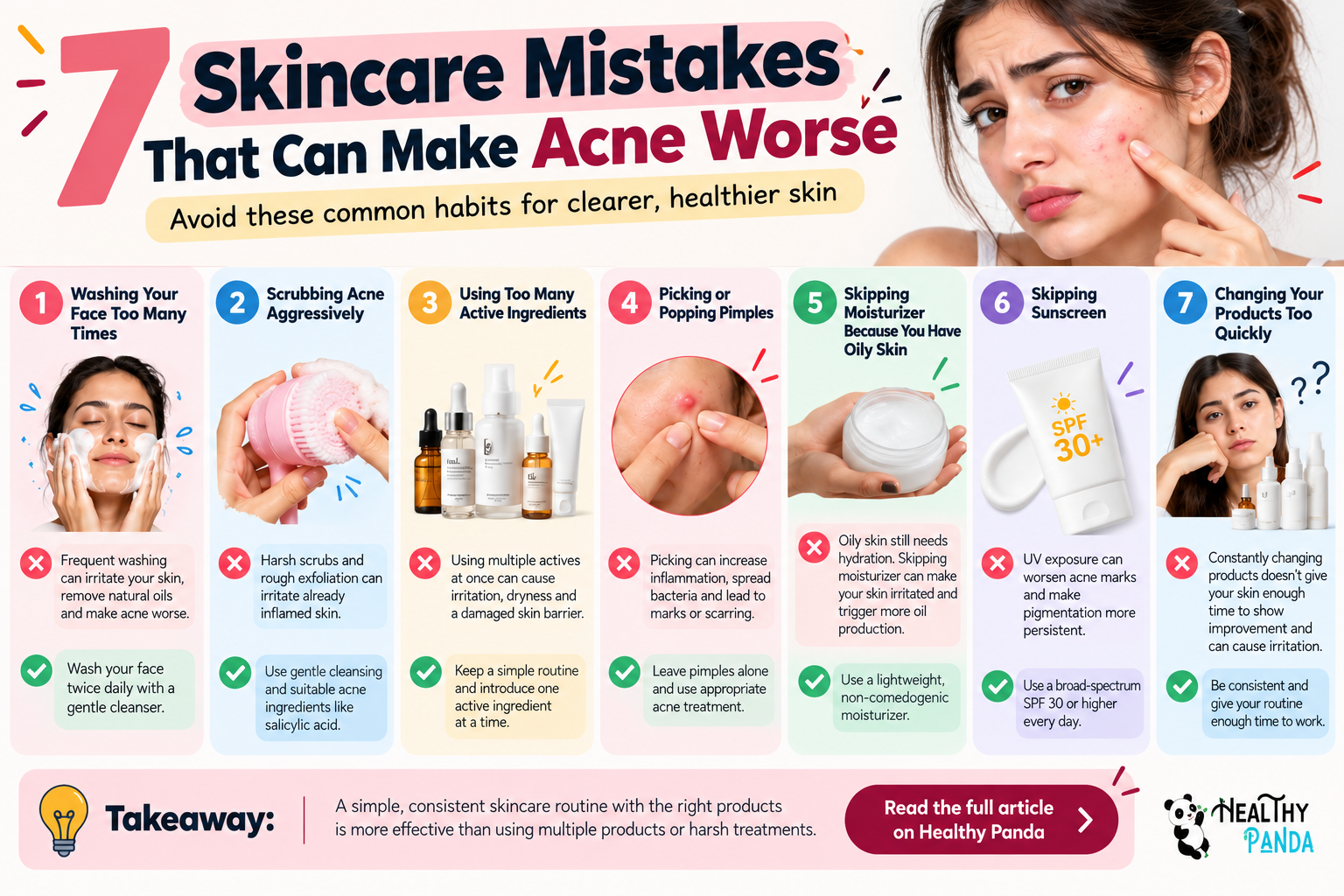
Acne isn’t always caused by “dirty skin.” In fact, some common skincare habits can irritate your skin, damage the skin barrier, and potentially make breakouts look worse.
If you’re struggling with pimples, blackheads, whiteheads, or acne marks, changing a few habits may be more useful than continuously adding new products.
Here are 7 common skincare mistakes that can make acne worse.
1. Washing Your Face Too Many Times
If you have oily skin, it can be tempting to wash your face repeatedly throughout the day.
But more cleansing isn’t necessarily better.
Frequent washing and harsh cleansing can irritate the skin and contribute to dryness. The American Academy of Dermatology recommends gently washing acne-prone skin and avoiding excessive scrubbing.
What to do instead
Wash your face twice daily and after excessive sweating using a gentle cleanser.
2. Scrubbing Acne Aggressively
Scrubbing your face with physical scrubs, brushes, or rough towels won’t “remove” acne.
Instead, aggressive exfoliation can irritate already-inflamed skin.
Avoid:
- Harsh physical scrubs
- Rough exfoliating brushes
- Scrubbing active pimples
- Rubbing your skin with a towel
Better approach
Use gentle cleansing and, when appropriate, a scientifically supported acne ingredient such as salicylic acid.
3. Using Too Many Active Ingredients
This is one of the biggest skincare mistakes.
You might use:
Vitamin C + AHA + BHA + retinol + benzoyl peroxide + niacinamide
because each ingredient has a different benefit.
The problem?
Your skin may not tolerate all of them together.
Irritation can lead to redness, dryness, burning and a damaged skin barrier.
The simple rule:
Don’t build your skincare routine around the number of active ingredients you can use. Build it around what your skin actually needs.
4. Picking or Popping Pimples
That satisfying feeling when you squeeze a pimple can come with an unwanted consequence: more inflammation and a higher risk of marks and scarring.
Picking can push inflammation deeper and injure the surrounding skin.
Instead:
Leave the pimple alone and use an appropriate acne treatment.
For an occasional inflamed pimple, a hydrocolloid patch can also help prevent touching or picking.
5. Skipping Moisturizer Because You Have Oily Skin
Oily skin still needs hydration.
If your skin feels dry and irritated after acne treatments, adding more and more drying products isn’t necessarily the solution.
Look for a non-comedogenic moisturizer that feels comfortable on your skin.
Look for:
- Lightweight textures
- Non-comedogenic formulations
- Ingredients that support the skin barrier
6. Skipping Sunscreen
Sunscreen isn’t just about preventing sunburn.
UV exposure can worsen the appearance of post-acne dark spots, making them more noticeable and persistent.
Choose a broad-spectrum SPF 30 or higher and apply it during the daytime.
If you’re prone to acne, look for a sunscreen that is labelled non-comedogenic.
7. Changing Your Products Too Quickly
You start a new serum.
Three days later, you don’t see a difference.
So you buy another serum.
Then another.
This is a common skincare trap.
Many acne treatments require consistent use over time before their effects can be properly evaluated.
Constantly changing products also makes it difficult to identify which product is helping—or irritating—your skin.
Better approach
Introduce one new active product at a time and give your routine enough time before deciding whether it works.
A Simple Acne-Friendly Skincare Routine
You don’t need a 10-step routine.
Morning
Gentle cleanser → Moisturizer → Broad-spectrum SPF 30+
Night
Gentle cleanser → Appropriate acne treatment → Moisturizer
The specific treatment depends on your type and severity of acne.
When Should You See a Dermatologist?
Don’t rely only on skincare products if you have:
- Painful deep acne
- Cysts or nodules
- Significant acne scarring
- Acne that keeps getting worse
- Acne affecting your confidence significantly
- Breakouts that don’t improve with appropriate over-the-counter care
A dermatologist can determine the type and severity of acne and recommend appropriate treatment.
Frequently Asked Questions
Can skincare cause acne?
Some products can contribute to clogged pores or irritation in susceptible people. Choosing products labelled non-comedogenic can help reduce the likelihood of pore clogging.
Is scrubbing good for acne?
No. Aggressive scrubbing can irritate acne-prone skin and isn’t an effective treatment for acne.
Should I moisturize acne-prone skin?
Yes. Acne-prone skin can still become dry or irritated, particularly when using acne treatments. Choose a suitable non-comedogenic moisturizer.
How long does acne treatment take to work?
It depends on the treatment and severity of acne. Don’t expect significant improvement after only a few days. Consistency matters.
Final Takeaway
When it comes to acne, more skincare isn’t always better skincare.
Avoid aggressive scrubbing, excessive cleansing, picking pimples, constantly changing products, and using too many active ingredients simultaneously.
A simple, consistent routine with appropriate acne treatment, moisturizer and sunscreen is usually a better starting point.
Medical disclaimer: This article is for educational purposes only and does not replace an examination or individualized medical advice from a dermatologist.
